
Article · 5 November 2026 · 4 min read
We build Streamlane in Streamlane
How an agent takes a piece of work from an item to a merged change in seven stages, and why every change still traces back to a decision a person made.
The item is the brief
Streamlane is work management built for teams and agents. We build it with Claude, and we track that work in Streamlane itself, in a team of its own. More than 800 pull requests merged into Streamlane in its first four weeks.
Nobody reads 800 diffs. What a person can do is decide what each change is for before it is written, and check that it did that. Everything below is built around that.
Every change starts as an item: a task, a bug or an idea, written in plain language, with acceptance criteria where they help. The item is the brief. It is also where everything about the work ends up, so the next person, or the next agent, can find it without asking.
Seven stages, on the item
When work starts, the item gets a working session with seven stages: Review, Refine, Spec, Build, Review environment, Feedback and Ship. The item's page shows them as a strip with the current one marked, and says whose move it is: the agent's, or a named person's. The stage moves as the work does. A person can move it by hand only by giving a reason, which the item's history keeps.
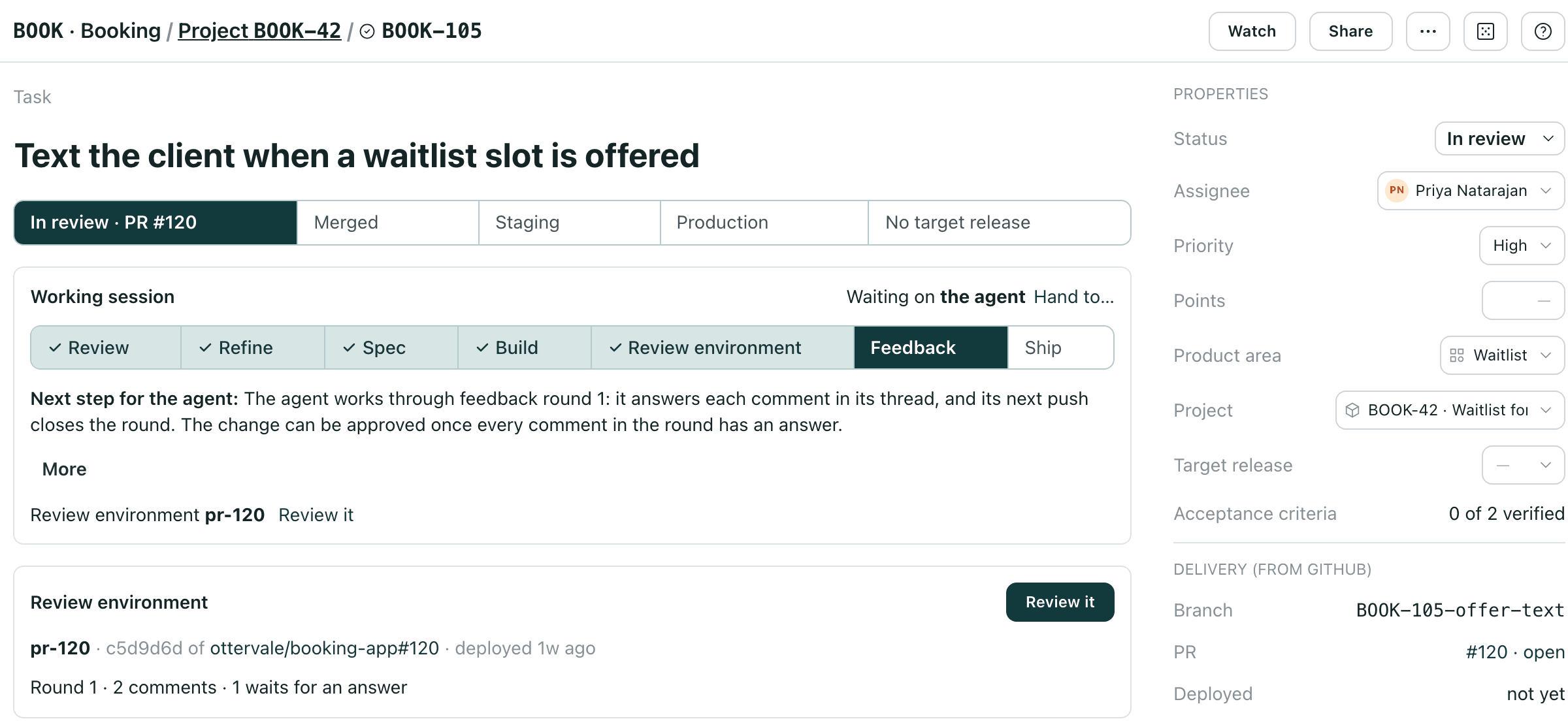
A person starts the agent from the item, either by opening it in Claude Code or by assigning it to Claude, which runs it in the repository on GitHub. Either way the agent signs in as that person, with their rights and nothing more, and everything it does on the item says it was Claude Code, for them.
The agent asks instead of guessing
Before it changes any code, the agent reads what the product already promises in the area it is about to touch: the behaviors, the rules each one keeps, and the code accountable for each.
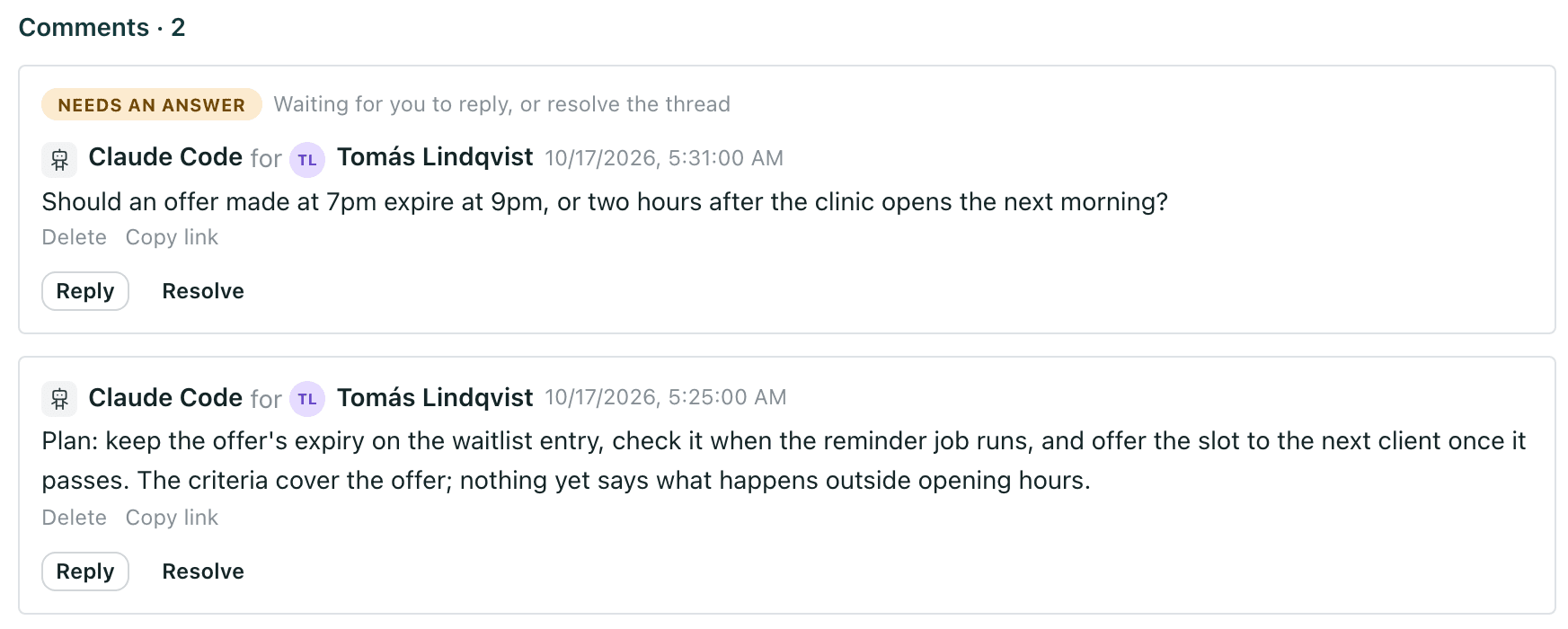
It posts its review and its plan on the item. When it needs a decision, it asks on the item, and the question waits in that person's Inbox until they answer it in its thread. Meanwhile the session says it is waiting on them. The agent does not guess at product decisions, and it does not quietly settle an ambiguity that a person should settle.
Each person has one list of the work in motion: every session they started or that waits on them, across teams, with its stage.
The change carries its own account
The agent opens a pull request that names the item, so the two link up and the item shows the pull request and its checks. The pull request carries the code, and it also carries the change to the product's written promises, kept as Intentset records beside the code: which behaviors were added or changed, and which rules now apply.
The gates run on every pull request: formatting and lint, duplication, types, unit and contract tests, and a review of the product's records against what changed in the code. A change to the code with no change to what the product says it does fails that review, unless the change states outright that no behavior changed. So does an approved promise that no test verifies.
When a person should try the change, the pull request gets its own review environment, opened from the item. Their comments come back to the agent as a round of feedback, which it answers comment by comment and closes with its next push. An acceptance criterion they tick there records the environment and the commit it was checked on.
A person approves what the product should do
The session cannot move past Spec while the change's records wait for approval. A person reads them in the item's Spec section, as what the product will do rather than as a diff, and approves them there. The approval is committed to the pull request in their name, and a check on the pull request reports it.
The agent never approves its own work, and the tooling refuses an approval from an agent's sign-in outright. Once the records are approved and every gate is green, the agent merges. Production is different: a person starts every deploy to it.
This is the part that matters most to us. The point isn't speed, though it is fast.
The point is that every change still traces back to a decision a person made, written down where the next person can find it.
Why we work this way
We are building tools for teams whose software is increasingly written by agents. The fastest way to learn what those teams need is to be one. Every rough edge we hit building Streamlane this way becomes an item in Streamlane, and waits for a person in the same Triage as everything else.
Streamlane is in development and open to invited guests. If you want to see it, get in touch.
Read next
Intentset before scale
A school assessment app wrote down what it promises before agents took on most of its work. In the twelve days after, it merged 186 pull requests, and writing it down found security gaps code review had not.